THIS SITE HAS MOVED!

As of 9/18/15, this site has moved to www.jillygagnon.com

You can still read my blog posts here (you can also read them on the new site!), but visit www.jillygagnon.com for current information on everything else!
Showing posts with label young adult. Show all posts

Tuesday, September 1, 2015

Like-Minded Individuals

Clearly I've been a lazy blogger.

Bad. Bad Jilly. Shame on you.

But as usual, I have an excuse, and as less-usual, it's a pretty good one: I've been busy finding my people!

Last year at a writing retreat, I met the fantastic Kim Savage, who told me about a group she was in, the Sweet 16s. It was a group of writers, all of whom were having their first YA or middle grade novel debut in...you guessed it, 2016.

Clearly, the minute I heard about The Swanky 17s I raised my hand as high as it would go and started shaking in my seat, hoping they'd pick me.

They did--hooray!

In the last two weeks we've been kicking it into seriously high gear, getting the website up and running (thank you infinitely, Sara Biren!), the twitter account active, and all our ducks lined up so we can start welcoming our fellow 17ers.

A couple of the things people tell you about this process that's impossible to believe before it happens to you are 1) how slowly publishing schedules move, and 2) how much of your work as an author is about finding interesting ways to get your books to readers.

Thankfully, the Swankies are helping me manage both of those. I can't imagine a better way to spend the 18+ months between now and my book actually existing than connecting with other authors (with books that I can't wait to read), promoting our work together, and--let's be honest--knowing who to turn to when the headaches and the nerves and the frustration and the elation start coming fast and thick.

Of course I've also been working to get the 2016 comedy debut lined up and ready to go...

...but that's another story.

Wednesday, April 1, 2015

The First Day of the Rest of Your Life (Hopefully)

It's official. After nearly two years of forcing myself into an ill-fitting 9-5:30 lifestyle, today is the first day that I'll be working primarily for myself, primarily on my capital-w Writing, doing the thing I've been desperately trying to get anyone to let me do for almost a decade.

It's pretty terrifying.

Luckily, having a ton on my plate right from the start is helping. As is having amazing coworkers (with some serious personal space issues):

Friday, March 13, 2015

Book Deal News

I've been a little spotty about posting here lately, but I swear, I have a good excuse.

Actually I have good excuses.

Last week I got an offer for my YA debut, #famous, from HarperCollins imprint Katherine Tegen.

Which is enough to make me vomit rainbows for about a year, especially since I get to do it with the FABULOUS editrix Anica Rissi, supported by the EQUALLY fabulous agent-extraordinaire Heather Alexander.

But wait, there's more.

Friday, February 27, 2015

No Boys Allowed?

I came across a really frustrating but thought-provoking post this morning by Shannon Hale (h/t Sharyn November) that commented on the general attitude--and the specific times Hale as a writer had seen it playing out--that many, many children's books are "just for girls."

Frustrating because it reinforced what so many of us know in our guts but (until you're as successful as Hale and therefore able to collect a bit of your own data) can't necessarily "prove" :

That books by women, and books with female protagonists, are exclusively billed as being for girls, so much so that many boys quickly learn to be too ashamed to even consider them.


Even author visits to a school--something I'd think of as a one-perspective version of career day--are segregated; Hale talks about the several times she's found herself speaking to a conspicuously female crowd, though male authors had addressed the entire school.

There's a lot of talk in the kid's lit world about boy readers--how we lose them, often, and how we need to fold them in.

But clearly we're not expecting parents, and educators, and ourselves to give them "girl" books as part of that effort. We're not taking "girl" books and telling boys "there are good reasons to like this."

It should go without saying, but clearly it isn't being said enough: reinforcing the idea that stories about more than half the population are somehow not worthy of male attention makes it very, VERY hard to argue that female people are worthy of the same level of thought and respect as male people.

Teaching boys and girls both that female stories are specific but male stories are universal is a gut-punch to really valuing those groups of stories, and of people, equally. We always try to bill reading as a way to open your mind and see new worlds and develop empathy, and yet we're not asking boys--are in fact making it shameful and difficult for them--to open their mind to girlhood.

This isn't just a problem with "boy" books and "girl" books--it's a problem for all kinds of sub-categories. Books that feature diverse characters, or LGBT characters, or disabled characters, or, or, or, shouldn't exist SOLELY to make those groups feel like literature finds value in their experiences. Those books should also be something we push to every other kid, kids who don't fit those specific boxes, so that they realize this is an experience that is as valid as their own. You can't normalize anything by keeping it "other."

Sigh.

I'd cry about it, but that would be such a GIRL thing to do.

Tuesday, December 30, 2014

Signs You're on the Right Track

I'm just starting a new project, and it's in that extremely exciting phase where you haven't realized all the traps you've set for yourself, yet, and you fool yourself into thinking maybe you really ENJOY this writing thing, and it's totally going to go smoothly this time, and probably every other time from here on it it will too, since clearly you've now figured the whole thing out.

Fool's paradise, I know. I feel like first chapters in a first draft are like the writerly version of doing whippets or something.

Except, you know, way less fun.

Thursday, December 18, 2014

Points of Reference

A few months back, when I still had girl hair, I needed to get it up off my neck.

"Hey, do you have a binder?" I asked the friend I was with.

"What?"

"A binder. A hair binder."

"What?"

"You know, a...I don't know, a ponytail holder."

"OH, a HAIR tie."

Uh, yeah. A binder.

Thursday, November 13, 2014

The Liebster Award Blog Hop

One of the best reasons to go to writing conferences: you meet AWESOME people there, people like the truly spectacular Julie Artz. I'm excited to say she nominated me for a sort of "writer's chain letter" blog tour where we get to learn about how we all work (or fail to). With no further ado, let me tell YOU about ME...and the people that come out of my head: 


Can you share one example of how you came up with the idea for a story? 

Well usually I come up with just the tiniest hint of a character. All my stories spin from characters.

One book (that's in a drawer right now) started with "what about a really dorky social misfit who's actually quietly picking off the people she got too obsessed with and who failed to live up to her idea of their 'friendship?'" Teasing out the two girls who wound up as the central characters in the story, and what they loved and hated, and how they got along, and what was actually going to HAPPEN was much more involved, but the story IDEA sort of came to me like a character logline.

Sometimes. Other times I go through something funny or sad or awful in life and I say "some day, when I'm ready, THIS is becoming a book."

Tuesday, September 16, 2014

What if YA Were More Like Literary Fiction?

I'll admit it. Lately, I've been losing patience. I've become intolerant. Things that used to seem charming are crawling around under my skin like a bad case of verbal bed bugs.

I speak, of course, of the "look at my verbal backflips" tendency in literary fiction.

What if YA were like that? By which I mean, what if YA were so impressed with the smell of its own farts (or just the sound of its own voice, you pick) that it spent hundreds and thousands of words talking about...nothing?

Even during the not-as-brief-as-it-should-have-been, Jilly-know-yourself-better-dammit period when I was trying to write semi-literary fiction myself, I found the long-winded description tedious at best.

I don't really care about all 73 shades of pink and coral and mother-of-pearl and Orange Julius tinting a sky, causing a character to reflect, boringly, on his own mortality and also his childhood. It doesn't change my understanding of the character, or the story, or the writer's ability, to slog through an entire page of an elaborately-constructed metaphor comparing two women's church hats to multi-colored, feathered Parthenons, marching bravely through time and the line at the post office atop their some-also-overly-clever-metaphor-for-hairs. And there's just never that much worth saying about how that one tree looked.

I don't want to read about those things, even when they're done well; why would I want to write them?

Oh god, I'm gonna have to read about SO MANY NATURE MOMENTS.

Monday, July 21, 2014

Why The CENSORED Wouldn't You Say CENSORED?

Let's just lay it out there: I swear like a sailor.

I'm totally capable of turning off the flow of four-letter words and inappropriate descriptions; I used to be a nanny, and my mother is far too Midwestern to let me get away with saying anything network TV wouldn't approve of, at least without me preemptively pardoning my French, or her post-emptively chastising my "language, Jilly"


Read: it's easier to just cut swears out of my discussions with my mom.

Barring those phone calls, I can express myself without any of my more colorful turns of phrase, of course...but why would I? Deployed correctly, they so perfectly capture not just what I mean, but how I feel about what I mean. Besides, I write comedy (among other things)--if the occasional swear offended me, or if I wasn't willing to push against at LEAST the "appropriate language" envelope, I might as well just give up now.

Or resign myself to the Reader's Digest jokes section, permanently.

A horse with BANGS? Now that's WACKADOODLE!!!!


Monday, June 16, 2014

Grown-Up Reactions to Kid Lit: Eleanor & Park

Jilly:  So can I just say up front, I'm always pre-skeptical of books that are set in the recentish (read: around when the author was probably a teen) past for no particular reason.

MK:  Ha. That's probably fair. It's hard to view recent history as appropriate for historical fiction.

Jilly:  I mean, so the author knows which bands would have made Park appropriately "cool" for 1986 Omaha. That's not enough of a reason to choose that historical moment

MK:  Okay, but I do think putting your characters in a mixtape era makes sense. It's hard to get that kind of visceral pull in a contemporary setting. "Here, I made you this spotify playlist."


Jilly:  Agreed. And it would be hard for her to get the same level of cut-offness for Eleanor. The concept of having no phone line--period--is just difficult to conceive of for any socio-economic level, these days

MK:  Yes. It's a fantastic marker for her poverty level. Although I wonder how well that works for an actual teen reader. The idea of not having a Walkman as a socio-economic indicator.

Jilly:  Well right, that's the thing that always knee-jerks me on recent-past books; the hallmarks you use may work for a crossover adult audience--the visceral feel of a mixtape you mentioned, the poverty level, the Smiths being cool--but they don't resonate for modern teens precisely because it's nothing they've ever experienced. I BARELY experienced that, and I'm an '84 baby. A 2000 baby is so far past it that it may as well be 1940s Russia, or 1804 Jane Austen

MK:  I think teen readers overlook those, though. The emotional pull works even if you're glossing over the references that don't really work for you.

Jilly:  Well she does totally nail the feeling of falling for someone. There's hardly even a plot, but I couldn't stop reading, and I think it's 100% because her descriptions of what it feels like (as per her own promise) let us remember what it's like to be that age, and be in love. Which I think applies even if you are that age--nostalgia for experiences that might be currently available is legit, too

MK:  Absolutely. I'm ordinarily not a huge fan of alternating POV (I get confused really easily, as I did whenever she shifted within a single chapter), but I love the way she captured how anxious they both are about themselves and each other, but how little they understand the other's emotions.

Jilly:  Right, and the momentousness of it all. The sense that you can't get enough of this person and it's almost physical: the desire to EAT Park; the embarrassment at being with Eleanor, but simultaneous inability to stop touching her hair; the sense of having no control over your experience because of this other person.

MK:  And the experience that suddenly your body isn't even your own because you never had someone touch you before. I think Park's viewpoint is really strong in that regard--he's just consumed by these relatively innocent touches and can't even handle thinking about going further.

Jilly:  Which I think is a good counterpoint--not that teens should think sex is taboo, but the idea that all boys always want only sex, that they CAN'T be embarrassed or nervous or unsure about it, seems negative to me

MK:  YES. It is very very rare to get a male POV with a budding relationship that isn't all about being horny.

Jilly:  But do we think boys would ever read this book? You would know more about this, as a librarian who actually ENCOUNTERS teen boys. I mostly avoid them on buses and sidewalks.

MK:  I think the cover would detract a lot of boys. I think there are absolutely boys who would read it on recommendation, but it reads as a little girly.

Jilly: And the write-up is all about romance, which just vibes "girl" at any age.

MK:  Which is really too bad, because I think there are a lot of other ways to sell the story.

Jilly:  Right. The cultural disconnect, and feeling of outsiderness that both characters have is definitely something I could see having cross-gender appeal to a sensitive, Park-esque boy, at least.

MK:  The music, too.


Jilly:  Totally. Okay, so here's my elephant in the room: do we buy that a teenager as seemingly cynical as Eleanor  would believe she's in love? I may have been the only teenager ever with this particular brand of precocity, but I definitely remember feeling--AT THE TIME--that teenagers weren't REALLY in love, and that it was kind of idiotic to call things that.

MK:  Oh I don't think she believes that at all.

Jilly: But don't we think the three-word postcard at the end had to be "I love you?"

MK:  See, I don't love that ending. Because I totally buy her thinking they're doomed from the start.

Jilly:  I didn’t either! It felt like a cop-out to me. Like a concession, rather than what she really felt would happen

MK:  That's a really apt way to put it. Writing the postcard feels like her giving in.

Jilly:  Both the author AND Eleanor

MK:  Yes!

Jilly:  I have to Giver this one (which is my way of saying ask about the after-the-end): do you think they get back together?

MK:  (My mom loves to Giver.) I think the ending implies that they do, which is super unfair.

Jilly:  It seems like kind of a cowardly ending.

MK:  I really think it's a disservice to the rest of the book, which gives a lot of room for things to be uncomfortable and unsettled.

Jilly:  And it closes off a much more realistic experience, to my mind: you will love someone first, and you will probably lose them. Not losing them in a way stiffs the characters. Do they not grow or move on? It amber-seals them. I feel like that's what first love did for me: it may or may not have been real, but it taught me about ME.

MK:  Yeah. I think the rest of the book does a really good job at showing you that "love" doesn't fix the rest of your life, it just provides a little cocoon from it for a while.

Jilly:  And it shows that even in still-loving relationships--like Park's parents'--love isn't that intense for long. They kiss every day, but it's as much habit as passion, I feel like.

MK:  Good point.

Jilly:  Overall, though, I loved it. She flubbed the landing a bit, but it was a really touching book.


MK:  Agreed. 

Monday, June 2, 2014

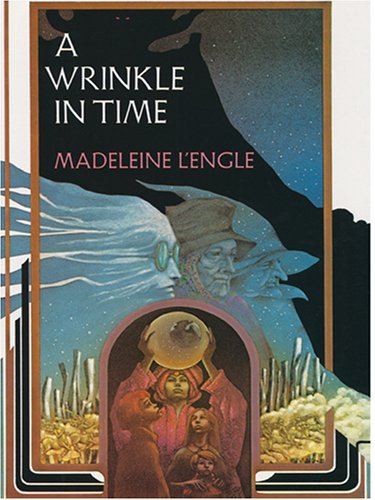
Slaughtering Sacred Cows: A Wrinkle in Time

Recently, I chatted with a friend about Harriet The Spy, a book that I was overjoyed to discover was even better than I had remembered.

But there are some books that you go back to, thinking that as certified "classics" they're sure to stand the test of time, and you realize that kid-you must have been much less discriminating than adult-you has become.

I'm sorry to have to say it, but that's what happened with A Wrinkle in Time.


I had only the vaguest memories of the book, and they were mainly that it was very complicated. I think I must have originally picked it up around the age of 7 or 8, and it was just over my head; jumping through space-time with a 5-year-old who speaks like an olde tyme BBC production was lost on me...

...as was the incredibly heavy-handed moralizing.

I know the idea of teaching a moral lesson in kid's lit isn't new; in fact for many people it's one of the many "musts" of children's stories. But the incredibly overt strain of indoctrination that permeates certain books--the Narnia series is the other prime example I can think of--is just so hard to ignore as a grown-up.

Rereading this felt like when I read Ayn Rand again at 20. At 14, it seemed SO PROFOUND. Being capable of picking up on an actual theme in a book--one which was intended, with all the subtlety of a sledgehammer--made me feel so smart that I thought I liked Rand's writing.

When I revisited it with a formed brain, it looked more like what it was: very thinly-veiled propaganda being spouted by wooden characters.

At least Madeline L'Engle wasn't a Randian...but she was clearly a devout Christian, and the ways in which her pet philosophy continually crops up in this book (and presumably the later titles in the series, none of which I'll be rereading) become just as ham-handed by the end.

That wasn't even my only issue with the book--L'Engle's 14-year old protagonist reads like a young 10-year-old, which is always a pet-peeve for me, and her main character traits seem to be stubbornness and wanting to hold hands, making her remarkably 2-dimensional for a book that explores a fifth one--it's just my most prominent gripe.

It's not even the content of the philosophy that's problematic, it's the way it's deployed: SO OBVIOUSLY. Am I the only one who just can't get behind this book? Have I just alienated everyone ever by calling a spade a would-be-indoctrination-manual?

Tuesday, May 27, 2014

New Essay on Young Adult Review Network

Usually I'm snarky, or sarcastic, or otherwise deflect-y, because THAT'S HOW PEOPLE DEAL WITH EMOTIONS, RIGHT?

Well, some people. 

Today, though, I wrote an essay for the Young Adult Review Network about one of the many absurd events that orbited around my dad's death. A version of this moment made it into my young adult novel, It Could Be Worse (still looking for representation, possible agent soul-mates!). I'll give you the classic teaser paragraph here; I'd love you to continue reading it there! 

Our Father, Who Art in Heaven (Maybe...)


Note: while I’ve tried to be as honest as possible in this essay, it’s just one person’s memory of very complicated events. It’s not “the” truth, just one version of it. -Jilly
We’d already done the hushed-voices, bedside consultation about whether it was time to pull the plugs.
We’d already suffered through the shock—in one of the endless meetings with the doctors during that last week—of learning that P., the woman we thought of as my dad’s girlfriend, had in fact secretly married him about a week after the attacks started, and in the four months that followed, had told no one. Which made her my secret-stepmother. Which  thought made the inside of my stomach itch.
We’d even managed to make it through the last, agonizing moments, after they pulled out the ventilator that had been keeping him alive; the gurgling, gasping, knocking sounds bubbling up from his weakened lungs as they tried—and failed—to draw breath; the moment, just like in the movies, when the heart monitor’s syncopated rhythm collapsed into a single, drawn-out note, filling the space where my dad used to be with its agonizing, unending screech.
Somehow, it never occurred to me to dread the meeting with the priest.
Naïve, naïve, naïve.
Read the rest at the Young Adult Review Network, an awesome spot for young adult readers and writers!